Lecture 06: Experimental Design and Validity
Experimental Design in Education
2025-02-24
Effect Sizes and Practical Importance
This section carries forward the five-group ANOVA example from Lecture 05. Statistical significance addresses whether the data are inconsistent with a null hypothesis; effect size addresses how large the observed association or difference is.
What Are Effect Sizes?
- An effect size quantifies the magnitude of an effect beyond statistical significance.
- A p-value depends partly on sample size and does not, by itself, describe the strength of a relationship.
- With other features held constant, increasing the sample size can produce a smaller p-value without increasing the effect magnitude.
- Effect sizes provide context for interpreting practical importance.
- In scientific experiments, it is useful to know not only whether an effect is statistically detectable, but also how large the observed effect is.
- Common measures include eta squared (\(\eta^2\)), omega squared (\(\omega^2\)), Cohen’s \(d\), and Hedges’ \(g\).
Note
Many psychology journals require researchers to report effect sizes alongside inferential test results.
The following setup reloads the Lecture 05 data so this lecture can be rendered independently.
Eta Squared
- Eta squared (\(\eta^2\)) is the proportion of total outcome variance explained by the independent variable.
- Formula: \(\eta^2 = \frac{SS_{Model}}{SS_{Total}}\)
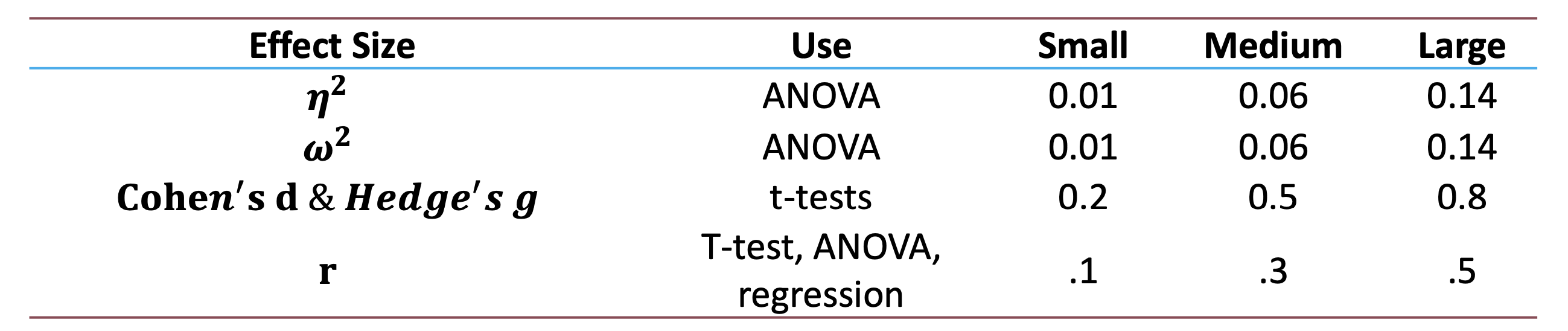
- Conventional reference values are 0.01 (small), 0.06 (medium), and 0.14 (large). These are context-dependent guidelines rather than universal cutoffs.
           Df    Sum Sq   Mean Sq  F value      Pr(>F)
group       4  89.36792 22.341980 4.467411 0.002017278
Residuals 135 675.14886 5.001103 NA NAInterpretation: Academic program explains 11.69% of the observed variance in growth mindset scores. Under the conventional reference values, this is between a medium and large effect.
Drawbacks of Eta Squared
- In models with multiple independent variables, the variance attributed to one variable depends on what else is included in the model.
- This can make the effect of a single variable difficult to compare across differently specified models.
- Partial eta squared uses the variance explained by the focal variable plus its associated error variance as the denominator; variance attributed to other variables is excluded.
- Eta squared and partial eta squared are equal in a one-way ANOVA, but they generally differ in models with more than one independent variable, such as factorial ANOVA.
- Eta squared is upwardly biased as an estimate of the population proportion of variance explained.
- The bias diminishes as sample size increases. Omega squared applies a correction and is generally less biased, particularly in modest samples.
Omega Squared
- Omega squared (\(\omega^2\)) has the same general interpretation as eta squared but applies a bias adjustment to the estimated proportion of variance explained.
- It is typically smaller than eta squared in the same sample.
- Formula: \(\omega^2 = \frac{SS_{Model} - df_{Model} \cdot MSE}{SS_{Total} + MSE}\)
- The same conventional reference values are sometimes used, but substantive interpretation should depend on the research context.
           Df    Sum Sq   Mean Sq  F value      Pr(>F)
group       4  89.36792 22.341980 4.467411 0.002017278
Residuals 135 675.14886 5.001103 NA NA[1] 0.09013892Compute Effect Sizes Using the effectsize Package
For one-way between subjects designs, partial eta squared is equivalent
  to eta squared. Returning eta squared.
# Effect Size for ANOVA
Parameter | Eta2 | 95% CI
-------------------------------
group | 0.12 | [0.03, 1.00]
- One-sided CIs: upper bound fixed at [1.00].For one-way between subjects designs, partial omega squared is
equivalent to omega squared. Returning omega squared.# Effect Size for ANOVA
Parameter | Omega2 | 95% CI
---------------------------------
group | 0.09 | [0.01, 1.00]
- One-sided CIs: upper bound fixed at [1.00].Effect Sizes for Planned Contrasts
- A correlation-based effect size for a contrast can be calculated as \(r = \sqrt{\frac{t^2}{t^2 + df}} = \sqrt{\frac{F}{F + df}}\).
- For example, when \(t = 2.49\) and \(df = 135\), \(r = \sqrt{\frac{2.49^2}{2.49^2 + 135}} = 0.21\), a small-to-moderate magnitude under common reference values.
              Estimate Std. Error    t value     Pr(>|t|)
(Intercept)  3.2869286  0.1890031 17.3908736 2.818829e-36
group1       0.9630714  0.3780061  2.5477666 1.196166e-02
group2      -0.5280000  0.3780061 -1.3968027 1.647649e-01
group3       0.2577143  0.3780061  0.6817727 4.965506e-01
group4 0.5698571 0.3780061 1.5075341 1.340104e-01[1] 0.831 0.214 0.119 0.059 0.129- Excluding the intercept, these coefficient-level effect-size magnitudes range from 0.059 to 0.214. Because the square-root formula returns nonnegative values, read the direction from the corresponding coefficient sign.
Cohen’s \(d\) and Hedges’ \(g\)
- These measures are commonly used for simple mean comparisons.
- Cohen’s \(d\) is \(d = \frac{M_1 - M_2}{SD_{pooled}}\).
- Hedges’ \(g\) corrects Cohen’s \(d\) for small-sample bias.
- Conventional reference values for \(d\) and \(g\) are 0.2 (small), 0.5 (medium), and 0.8 (large), but the practical meaning depends on the outcome and research setting.
Guidelines for Interpreting Effect Size
- In this example, academic program has a statistically significant association with growth mindset scores, \(F(4, 135) = 4.47\).
- Academic program explains 11.69% of the observed variance in growth mindset scores (\(\eta^2 = 0.1169\)), which falls between the conventional medium and large reference values.
Tip
Report the inferential result and the effect size together: the test result addresses statistical compatibility with the null hypothesis, while the effect size describes the magnitude observed in the sample.
Randomized experiments allow researchers to scientifically measure the impact of an intervention on a particular outcome of interest (e.g., the effect of intervention methods on performance).
The key to a randomized experimental research design is the random assignment of study subjects:
- For example, randomly assign individual people, classrooms, or some other group into a) treatment or b) control groups.
Randomization has a very specific meaning:
- It does not mean haphazardly or casually selecting some participants and not others.
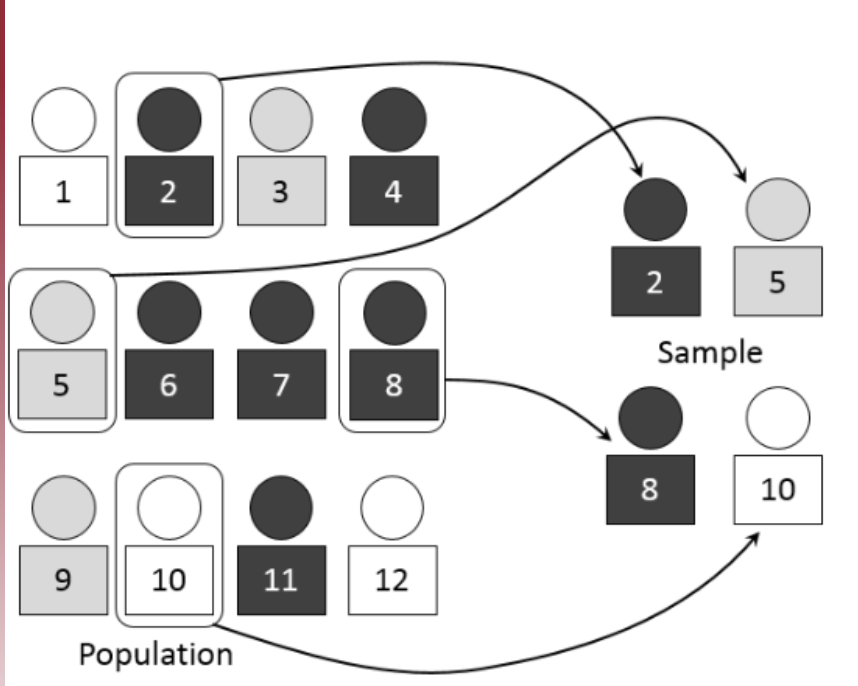
Randomization in this context means: care is taken to ensure that no pattern exists between the assignment of subjects into groups and any characteristics of those subjects.
- Ex: Not all females over 30 are in the exercise group, females 18-30 in the diet group, and males in the control group.
- Every subject is as likely as any other to be assigned to the treatment (or control) group.
Types of Validity
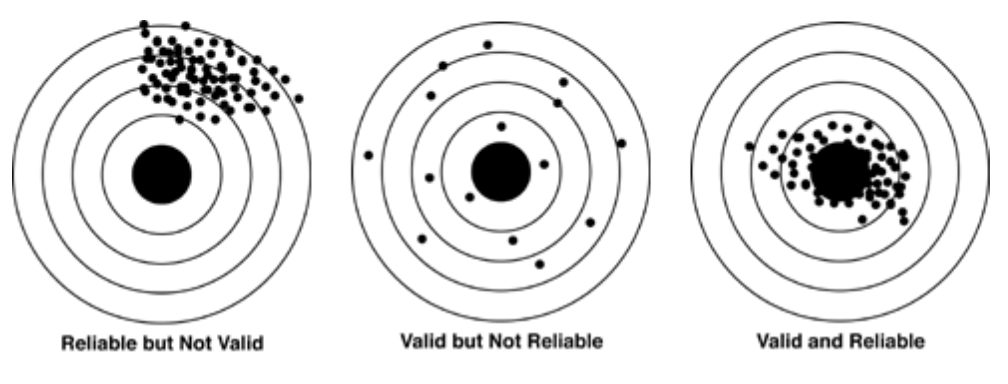
- Statistical Validity
- Internal Validity
- Construct Validity
- External Validity
Construct Validity IV
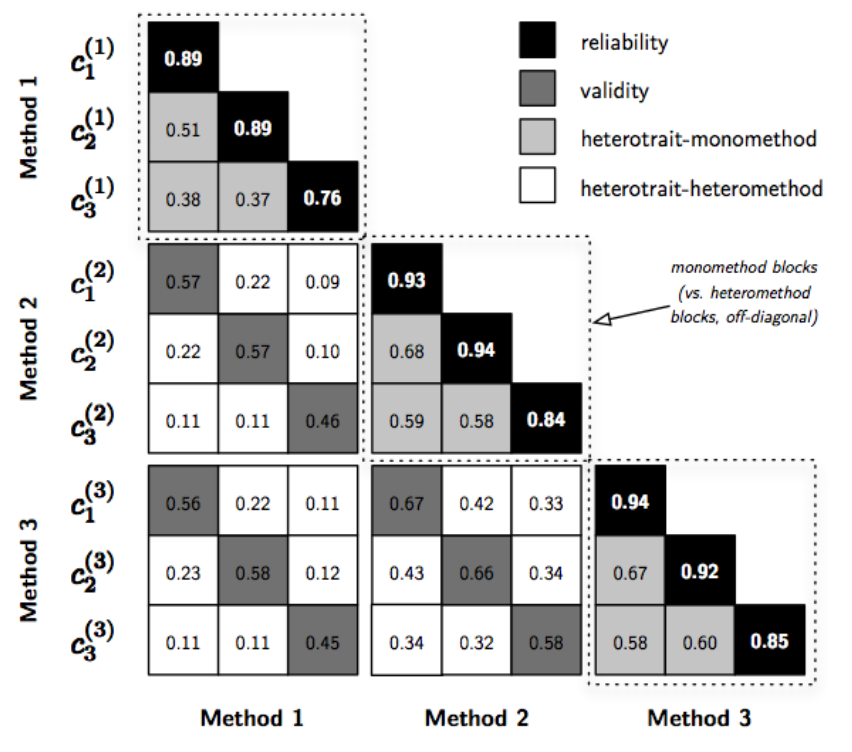
- Multitrait-Multimethod Matrix (MTMM):
- Example: Three traits to be measured: c1 (geometry), c2 (algebra), and c3 (reasoning).
- Each trait was measured by three methods.
- e.g., notation: \(c_3^{(2)}\) is trait 3 measured by method 2.
- Coefficients in the reliability diagonal should consistently be the highest in the matrix: a trait should be more highly correlated with itself than with anything else!
- Coefficients in the validity diagonals should be significantly different from zero and high enough to warrant further investigation.
- This is essentially used as evidence of convergent validity.